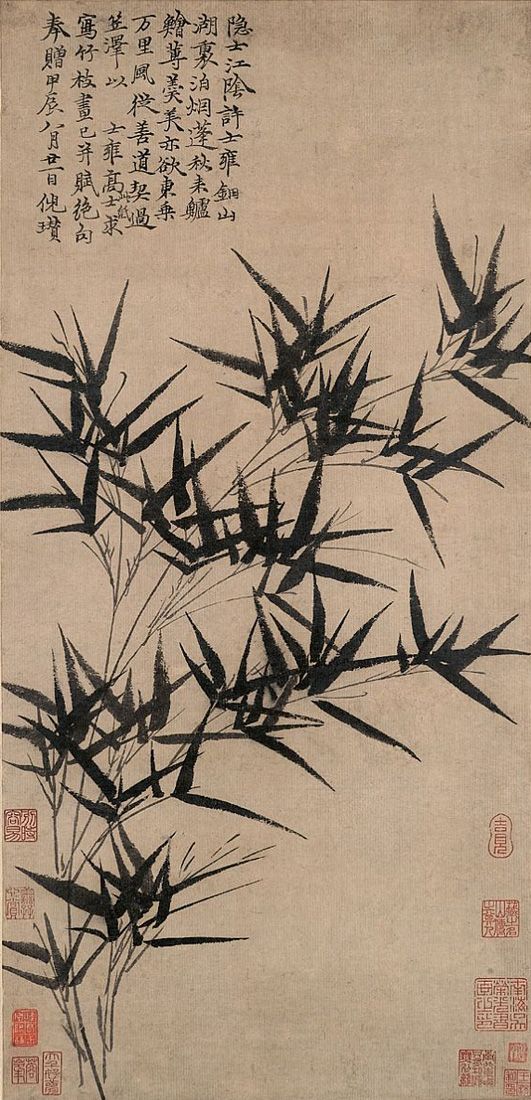
Bamboo and Plum Blossom

Bamboo and Plum Blossom

Bamboo and Plum Blossom

Bamboo and Plum Blossom

Saturday, July 18, 2015

Xue Tao (768-831)

On Cicadas


Dew-rinsed:
their pure notes
carry far.

Windblown:
as dry, fasting leaves
are blown.

Chirr after chirr,
as if in unison.

But each perches
on its one branch,
alone.
 
Xue Tao :

Friday, July 17, 2015

Yuan Zhen (779-831)

An Elegy 1


O youngest, best-loved daughter of Xie,
Who unluckily married this penniless scholar,
You patched my clothes from your own wicker basket,
And I coaxed off your hairpins of gold, to buy wine with;
For dinner we had to pick wild herbs
And to use dry locust-leaves for our kindling.
...Today they are paying me a hundred thousand
And all that I can bring to you is a temple sacrifice.
 
Yuan Zhen :

Thursday, July 16, 2015

Liu Yuxi (772-842)

Black Shirt Lane


By the bridge over Qin-wei River,
Wild flowers and grass had grown over.
In Black Shirt Lane, nothing much differed,
And at the entrance it was the same sunset ever.
Into the halls of dignities , the swallows once flown,
But now they are finding their way in ordinary homes.
 
Liu Yuxi :

Wednesday, July 15, 2015

Li Shen (d. 846)

Toiling Farmers —by Li Shen
李绅 《悯农》
锄禾日当午,
汗滴禾下土。
谁知盘中餐,
粒粒皆辛苦。

Toiling Farmers
By Li Shen
Farmers weeding at noon,
Sweat down the field soon.
Who knows food on a tray
Thanks to their toiling day?

This poem was written by the Tang Dynasty poet Li Shen who is known for expressing in-depth coverage of the rural life in his poems. The poem talks about farmers’ hard work for every single grain. The first two lines describe farmers keep toiling away despite the blazing heat at noon. The following two lines connect food in plate with farmers’ hard work. If they don’t toil, then who knows what you would eat.

Tuesday, July 14, 2015

Wang Bo (649-676)

Farewell To Vice-Prefect Du Setting Out For His Official Post In Shu — by Wang Bo
王勃《送杜少府之任蜀州》
城阙辅三秦,
风烟望五津。
与君离别意,
同是宦游人。
海内存知己,
天涯若比邻。
无为在岐路,
儿女共沾巾。
Farewell To Vice-Prefect Du Setting Out For His Official Post In Shu
By Wang Bo

By this wall that surrounds the three Qin districts,
Through a mist that makes five rivers one,
We bid each other a sad farewell,
We two officials going opposite ways….
And yet, while China holds our friendship,
And heaven remains our neighbourhood,
Why should you linger at the fork of the road,
Wiping your eyes like a heart-broken child?

This poem was written by Wang Bo in Chang’an City when his friend surnamed Du was leaving to take office as a county official in Sichuan province, the poet saw him off in Chang’an City and presented his friend this farewell poem. The poem describes their profound friendship and also expresses his sincerity and encouragement to his friend.

Monday, July 13, 2015

Li Qingzha (1084-1151)

A Quatrain in Summer — by Li Qingzha
李清照 《夏日绝句》
生当作人杰,
死亦为鬼雄。
至今思项羽,
不肯过江东。
A Quatrain in Summer
By Li Qingzhao

To be, one should be a rare fellow.
Not to be, one should be a ghost hero.
We have revered Xiangyu till today,
For he rejected alive as a loser way.

This poem was written by Li Qingzhao, a famous poetess who lived in the Southern Song dynasty (1127- 1279). The poem proposes her own viewpoint clearly in the first two lines: One as a human being should be an outstanding talent and make contributions to the country; if one has to die, he should make sacrifices for his country, becoming a ghost hero after death. The poetess felt very disappointed when the rulers of Southern Song just fled as the country was invaded aliens, disregard for common people. The poetess also used Xiangyu, a hero who refused to flee and committed suicide with dignity, to satirize the rulers, and at the same time she hoped heroic figures could recover the country’s lost territory.

Sunday, July 12, 2015

Shijing (anthology)

Guan! Guan! Cry The Fish Hawks — from Shijing
《关雎》
关关雎鸠,在河之洲。
窈窕淑女,君子好逑。
参差荇菜,左右流之。
窈窕淑女,寤寐求之。
求之不得,寤寐思服。
悠哉悠哉,辗转反侧。
参差荇菜,左右采之。
窈窕淑女,琴瑟友之。
参差荇菜,左右毛之。
窈窕淑女,钟鼓乐之。

Guan! Guan! Cry the fish hawks
on sandbars in the river:
a mild-mannered good girl,
fine match for the gentleman.

A ragged fringe is the floating-heart,
left and right we trail it:
that mild-mannered good girl,
awake, asleep, I search for her.

I search but cannot find her,
awake, asleep, thinking of her,
endlessly, endlessly,
turning, tossing from side to side.

A ragged fringe is the floating-heart,
left and right we pick it:
the mild-mannered good girl,
harp and lute make friends with her.

A ragged fringe is the floating-heart,
left and right we sort it:
the mild-mannered good girl,
bell and drum delight her.

This poem is the first poem of ancient anthology Shijing, the earliest collection of Chinese poems comprising 305 works of the Zhou Dynasty (1122-256 B.C.). It is a love poem describing that a young noble falls in love with a good and fair maiden collecting edible water plants, and hopes to marry her.

Saturday, July 11, 2015

Wang Wei (699-761)

王维的《九月九日忆山东兄弟》
独在异乡为异客,
每逢佳节倍思亲。
遥知兄弟登高处,
遍插茱萸少一人。
On The Mountain Holiday Thinking of My Brothers In Shandong
By Wang Wei
All alone in a foreign land,
I am twice as homesick on this day
When brothers carry dogwood up the mountain,
Each of them a branch-and my branch missing.

Friday, July 10, 2015

Wang Zhihuan (688-742)

王之涣 《登鹳雀楼》
白日依山尽,
黄河入海流。
欲穷千里目,
更上一层楼。
On The Stork Tower
By Wang Zhihuan
The sun beyond the mountains glows;
The Yellow River seawards flows.
You can enjoy a grander sight,
By climbing to a greater height.